An authorized retailer, not a marketplace guess
Goglycoeden is the USA Authorized GlycoEden Retailer. You are buying from a named US business with a published office address, not from a reseller listing you cannot trace.
Official product information
Sold by Goglycoeden, USA Authorized GlycoEden Retailer · Order desk +1 (302) 200-3480 · Read the whole panel
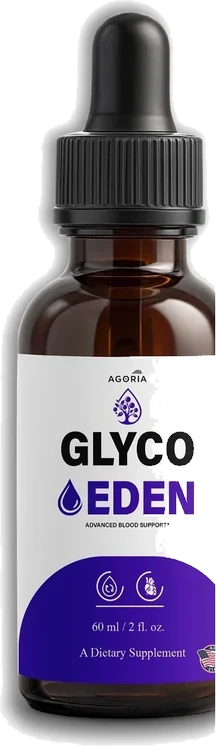
GlycoEden is a dietary supplement sold as liquid drops in a 60 ml / 2 fl. oz. amber glass bottle, under the Agoria brand mark. The Supplement Facts panel prints a serving of 2 droppers, about 2 mL, 30 servings a bottle and a 200 mg proprietary blend of berberine, bitter melon, ashwagandha and black pepper extracts. The bottle’s own directions read “take 1 or 2 droppers full daily” — which is not what the seller’s how-to-use panel says, and the bottle wins. No individual ingredient amount is published, and no pack price was supplied to us, so every price here reads “at checkout”.



 Marks describe the packaging. They are not an endorsement, and no supplement
is FDA approved. What each one means
Marks describe the packaging. They are not an endorsement, and no supplement
is FDA approved. What each one means

The short version
Twenty rows, every one of them read off the bottle or the seller’s own pack. Where a figure does not exist, the row says so — and where two sources disagree, both are printed.
GlycoEden in 60 seconds
GlycoEden is a dietary supplement sold as liquid drops, 60 ml / 2 fl. oz., in an amber glass dropper bottle under the Agoria brand mark. The Supplement Facts panel prints a serving of 2 droppers (about 2 mL), 30 servings a bottle and a 200 mg proprietary blend containing Berberine HCL (Berberis aristata) 30:1 root extract at 5%, bitter melon 10:1 extract, ashwagandha 10:1 extract (Withania somnifera) and black pepper extract. The bottle directs 1 or 2 droppers full daily; the seller’s how-to-use panel says 2 drops daily, which contradicts it, and the bottle is the regulated document. No individual ingredient amount is published. No pack price was supplied, so prices show at checkout, and no money-back window length is published anywhere in our sources.
200 mg blend. 30 servings a bottle. Four named extracts, three with ratios printed. Pack prices and the money-back window are on the listing, not here, because neither was supplied to us.
See the three packsStart here
People arrive in this category for one of two reasons, and they are not the same reason. The first is a number somebody read out to them at a check-up. The second is a vaguer feeling about energy, or about wanting to look after something before it becomes a problem.
If you are in the first group, the most useful thing this page can do is point you somewhere else first. MedlinePlus explains what blood glucose is and what the usual targets look like. NCCIH, the federal centre that reviews this exact question, gives advice in two halves that are worth reading in full: talk with your health care provider before taking a dietary supplement if you have diabetes, and do not take a dietary supplement instead of your diabetes medicine.
The FDA maintains a standing page on illegally sold diabetes treatments, which exists because products in this space have implied things they are not allowed to imply. Nothing on the GlycoEden label does that — the bottle says “Advanced Blood Support” with the FDA footnote, and that is the modest wording US law permits. But knowing where the line sits makes every other page on this site easier to read.
If you are in the second group, what a supplement can honestly offer is smaller: a daily habit built around botanicals, two of which have real federal summaries you can open and read in a minute. That is the market GlycoEden sits in, and the size of that claim is the most useful thing we can give you before you read anything else.
The product
GlycoEden is a liquid supplement. It arrives as 60 ml / 2 fl. oz. of liquid in an amber glass bottle with a rubber-bulb pipette in the cap. You shake it, draw up a dropper or two, and swallow.
The front of the bottle carries the brand mark AGORIA, a violet droplet-and-branch device, the product name GLYCO EDEN across two lines, the claim “ADVANCED BLOOD SUPPORT*”, two small icons in an indigo band, the volume 60 ml / 2 fl. oz., the words A Dietary Supplement and a small Made in USA flag.
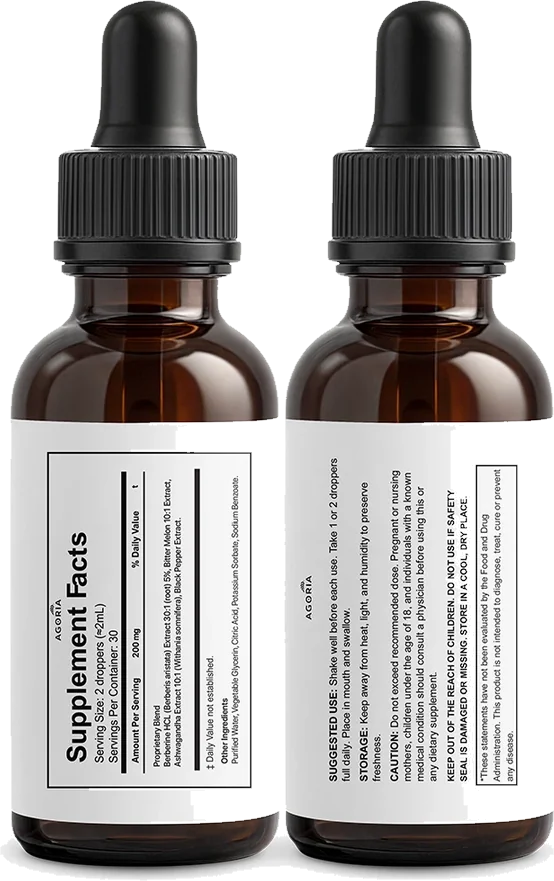
Turn it round and there is a full Supplement Facts panel: serving size 2 droppers (about 2 mL), servings per container 30, a 200 mg proprietary blend, four extracts named underneath with their ratios, a Daily Value footnote and a short other-ingredients line. Turn it again and the third panel prints the suggested use, the storage note, the caution and the FDA footnote.
Two sentences this site exists to say clearly. The first: 200 mg is the total for the whole proprietary blend, not the amount of each ingredient. The second, and the more important one: the bottle says droppers and the seller’s panel says drops, and those are not the same unit.
The honest section
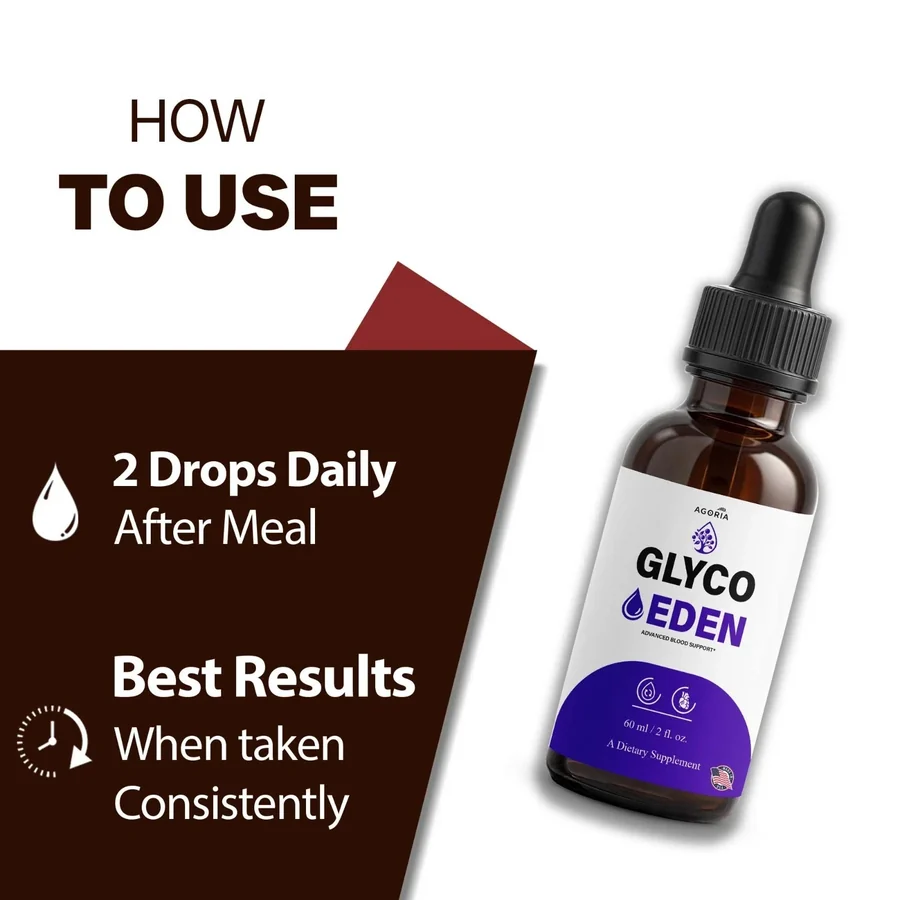
The seller’s how-to-use panel says “2 Drops Daily”. The bottle says “Take 1 or 2 droppers full daily”. Those are not the same instruction and they are not the same unit. A dropper full is roughly a millilitre; the panel itself declares a serving of two droppers at about 2 mL, which puts one dropper at about 1 mL. A drop is a fraction of that. Two drops is not a smaller version of two droppers, it is a different order of magnitude.
Follow the bottle, not the panel. Where a label and a marketing image disagree, the label is the regulated document and the image is not. The Supplement Facts panel and the suggested-use panel are part of the regulated label on the bottle in your hand. A square marketing image on a listing page is not, and it is the one that is wrong here.
The gap is not a rounding error. The panel’s own serving line puts two droppers at about two millilitres, which makes one dropper about a millilitre. A drop from a standard pipette is a small fraction of that. Following the panel instead of the bottle would mean taking a tiny fraction of the amount the 200 mg figure describes, and then concluding after a month that the product does nothing.
There is a second, smaller problem inside the bottle’s own wording: it gives a range. One dropper or two. At two droppers you are taking the serving the panel describes and the bottle lasts thirty days. At one dropper you are taking half of it, and the bottle lasts sixty. Both the strength and the cost per day move depending on which end you pick, and nothing on the label tells you how to choose.
Our advice is plain: take the bottle’s instruction, pick one end of its range, write down which one, and stay with it. If you want the seller’s own answer, the order desk is on +1 (302) 200-3480. The full how-to-use page →
Buying here
Six reasons, and the last two are the reason to trust the first four.
Goglycoeden is the USA Authorized GlycoEden Retailer. You are buying from a named US business with a published office address, not from a reseller listing you cannot trace.
+1 (302) 200-3480, for orders, tracking, changes and refunds. Most supplement sites in this category publish a web form and nothing else.
810 Seventh Avenue, Floor 9, New York, NY 10019, USA. It is on this site rather than behind a support ticket, and it is a different address from the office, which is normal and worth knowing before you post anything.
[email protected], Monday to Friday, 9:00am - 5:00pm ET. It handles this site: corrections, privacy and press. It cannot see orders, and we say so rather than letting you wait.
Not in a footnote. A site that sells this product and buries the one thing most likely to make a buyer take the wrong amount is not information, it is advertising with a disclaimer attached.
Three of the eight named buyers in the material we were given say the same sentence word for word, three more share a second, and the last two share a third. We publish the seller’s figures as the seller’s, and no testimony.
Mechanism
Seven steps. Six of them are real, and the seventh is the one the word “proprietary” makes impossible.
A botanical extract suspended in water and vegetable glycerin separates between doses. “Shake well before each use” is the first instruction on the bottle for a reason: an unshaken bottle gives you a weak dose at the start of the month and a strong one at the end of it.
“Place in mouth and swallow”, in the label’s own words. Liquids need no shell to break down and no water to take, and a dropper is the fastest daily supplement routine there is. Measure it against the pipette rather than counting drops.
200 mg of proprietary blend across berberine, bitter melon, ashwagandha and black pepper. The panel lists them in descending order by weight, which is the one thing a proprietary blend still tells you: berberine is the largest share and black pepper the smallest.
It is first in the blend, it is the only one given a plant part, and it is the only one with a standardisation figure. NCCIH reports that berberine “may have a modest effect on lowering blood glucose levels in people with type 2 diabetes and may reduce cholesterol levels”, and that plants containing it are currently being studied for effects on diabetes and heart disease risk factors.
A food crop across Asia, Africa and the Caribbean, and a fixture of this category. NCCIH’s page on dietary supplements and diabetes lists it among the herbal supplements studied and concludes that research has been limited and has not proven any of them effective. That is the whole of the mainstream position.
NCCIH’s findings on ashwagandha are about insomnia and stress, not about blood. Black pepper extract is standardised for piperine and is almost always included as an absorption aid. So of four named ingredients, one is a helper and one has a research record about something else.
Working out whether 200 mg is enough of anything. The panel gives extract ratios, which is more than most labels manage, but no amount against any ingredient. Two unknowns stack: how much of each extract is in the blend, and what that would mean if you knew.
We are not going to describe a mechanism for GlycoEden in the body, because no study of this formula exists and the ingredient split is not published. Read this section as a map of what the formula is built from, not as a claim about what it does for you — and not as a suggestion that it does anything to blood sugar, which the label does not claim and we will not either.
The formula
Four named, in the order the Supplement Facts panel prints them, which is descending order by weight.
Berberine HCL
The first and largest share of the blend, and the reason this product exists.
Berberine is a compound found in several plants. NCCIH describes it as “a substance found in a variety of plants, including goldenseal, barberry, Oregon grape, and others”. This label names the source species, Berberis aristata, prints the plant part as root, and gives a 30:1 extract ratio standardised to 5%. That is three more pieces of information than most labels in this category give you.
NCCIH reports that berberine “may have a modest effect on lowering blood glucose levels in people with type 2 diabetes and may reduce cholesterol levels”, and that plants containing it are “currently being studied for its effects on diabetes and risk factors for heart disease”. Modest, and being studied, are the operative words.
Amount in GlycoEden: not published Research reference: No agreed research dose; trials vary widely
Bitter melon extract
The second blood-sugar ingredient, and the one with the thinnest evidence file.
Bitter melon is a tropical vine grown as a food crop across Asia, Africa and the Caribbean; the fruit is eaten as a vegetable. The label prints a 10:1 extract ratio and does not name the species or the plant part.
NCCIH’s page on dietary supplements and diabetes lists bitter melon among the herbal supplements studied and concludes that “overall, research has been limited ... and hasn’t proven that any of these herbal supplements are effective”. That is the whole of the mainstream position, and it is worth reading before you buy.
Amount in GlycoEden: not published Research reference: No agreed research dose
Ashwagandha extract
The one ingredient here with a real body of human research, and a documented safety signal to go with it.
NCCIH describes ashwagandha as “an evergreen shrub found in parts of India, Africa, and the Middle East”, containing withanolides, compounds “associated with anti-inflammatory and antioxidant effects”. This label names the species and prints a 10:1 ratio.
NCCIH reports that “research shows that some ashwagandha preparations may be effective for insomnia and stress”, while “evidence is unclear about its effects on anxiety”. Note that neither of those is a blood claim, which makes its presence in an “Advanced Blood Support” formula a fair question for the seller.
Amount in GlycoEden: not published Research reference: Commonly measured in hundreds of milligrams of root extract in trials
Black pepper extract
Last in the blend, and not there for its own sake.
Black pepper extract is standardised for piperine, the compound that makes pepper hot. In supplements it is almost always included as an absorption aid rather than as an active ingredient in its own right. This is the only one of the four with no extract ratio printed beside it.
It is the industry’s standard bioavailability helper, which is a manufacturing choice rather than a health claim, and nothing on this label claims anything for it. Note the flip side: something that raises how much of one substance reaches the blood can do the same for a medicine you are already taking.
Amount in GlycoEden: not published Research reference: Used as an absorption aid, not as a dose in its own right
Tap any ingredient to open it. Every card ends the same way, because the panel ends the same way. Read the full ingredient page →
The honest section
GlycoEden publishes more than most of this category does — a real Supplement Facts panel, a declared blend total, two species named in full and extract ratios against three of the four ingredients. What it does not publish is how that total divides. So a dose-versus-research comparison can be made for the blend as a whole, and cannot be made for any single ingredient in it.
| What | Amount in GlycoEden | Research reference | Our reading |
|---|---|---|---|
| The whole proprietary blend | 200 mg a serving | Four extracts share it | This is the only amount published anywhere on the bottle. |
| Berberine HCL (root), 30:1 at 5% | not published | No agreed research dose; trials vary widely | Named species, named part, printed ratio - and no amount. |
| Bitter melon, 10:1 | not published | No agreed research dose | NCCIH: research has not proven these herbal supplements effective. |
| Ashwagandha, 10:1 | not published | Trials commonly use hundreds of mg of root extract | One trial ingredient can exceed this whole blend. |
| Black pepper extract | not published | An absorption aid, not a dose | The only one of the four with no ratio printed. |
Two things make this blend harder to size up than the arithmetic suggests. The first is that one of the four ingredients is not there to do anything on its own: black pepper extract is an absorption aid. The second is the label’s dosing range. At two droppers a day you take the 200 mg the panel describes; at one dropper you take half of it, and the panel’s figure no longer applies to what is in your mouth.
That is not an accusation. Plenty of formulas are built to be a daily habit rather than a clinical dose, and the label never claims otherwise — it says support, and it carries the FDA footnote. It does mean you should buy this as a habit, not as a strength, and it means the 200 mg on the front of our own summary is worth less than it looks until you know which end of the range you are taking.
The label
Three lines, four extracts, five other ingredients — and nine things that are not there.
Unlike much of this category, GlycoEden prints a full Supplement Facts panel. Here it is, transcribed off the bottle shot supplied in the assets.
‡ Daily Value not established. Other Ingredients: Purified Water, Vegetable Glycerin, Citric Acid, Potassium Sorbate, Sodium Benzoate.
The 200 mg figure sits on the Amount Per Serving header row rather than against the Proprietary Blend line beneath it. It plainly describes the blend — there is nothing else on the panel for it to describe — but it is set a row higher than a reader expects, which is worth knowing before you squint at a bottle.
Claims
One claim on the bottle, five lines on the seller’s panels, and then the list most pages in this category leave out.
The claim printed on the front of the bottle, with the asterisk that ties it to the FDA footnote. “Support” is the modest, legal wording for a supplement. Note what it does not say: it does not name a condition, a measurement or an outcome.
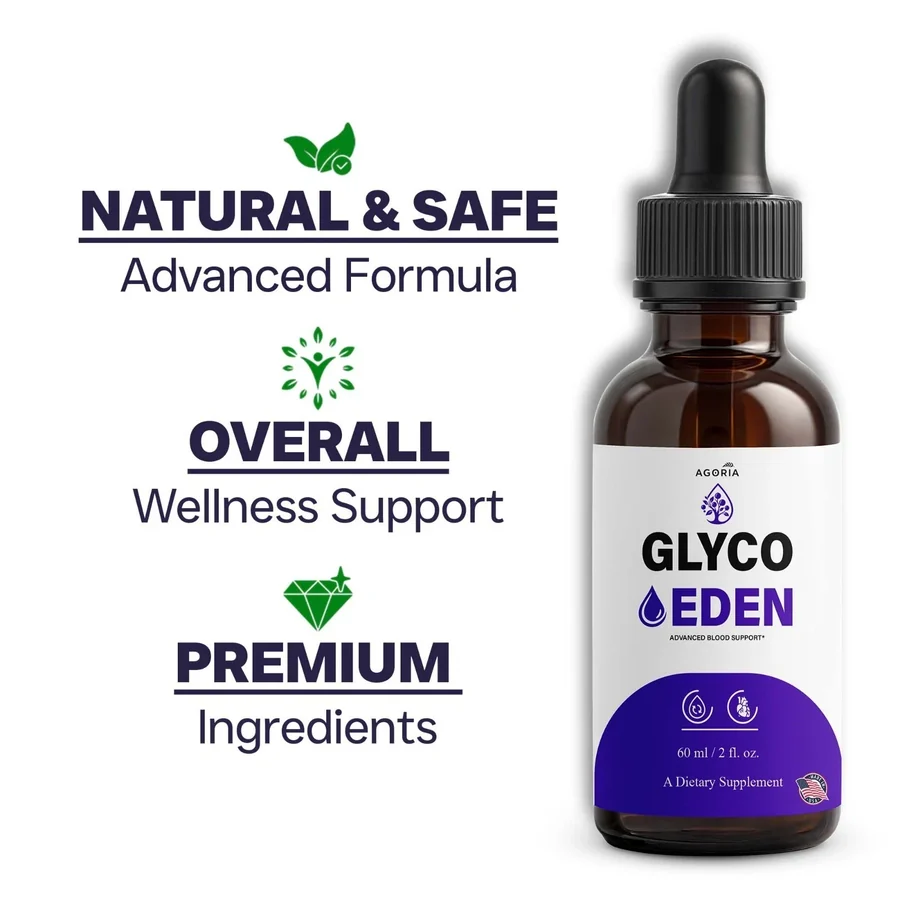
From the seller’s panel, not the bottle. “Natural” has no fixed legal meaning on a US supplement label, and “safe” is a claim no supplement can make about every person who will take it — NCCIH’s own notes on berberine and ashwagandha are on our safety page.
Also from the seller’s panel. About as broad as a structure/function claim can be while still being one. Read it as what the formula is offered for rather than what it delivers.
A marketing phrase, but there is something real underneath it worth crediting separately: two species named in full, a plant part for the largest ingredient and extract ratios for three of four. Judge the panel on those, not on the word premium.
Quoted from the material supplied to us. The first of those five contradicts the bottle, and the bottle wins.
It does not treat, prevent, cure or manage diabetes, prediabetes, high blood sugar, cholesterol or any other condition. Despite the “Glyco” in the name and the word “Blood” on the front, nothing on this label claims anything about a blood measurement, and US law would not permit it to. It does not replace prescribed medicine — NCCIH says plainly not to take a supplement instead of your diabetes medicine. It is not FDA approved, because no dietary supplement is. It has no published timeline and no trial of its own.
The honest section
Eight each. The right-hand column is the one worth reading twice.
Fit
This label rewards that. A named species for two ingredients, a plant part for one and printed extract ratios for three is more specificity than most of this category offers, and none of it is visible on the marketing images.
Drops go under the tongue and down in about four seconds. A supplement you actually take beats a stronger one that stays in the drawer.
A US order desk, a published office and a separate returns address. Being able to stop is worth something, particularly in a category this noisy.
This is the first line on this list for a reason. NCCIH’s guidance is explicit: talk to your health care provider before taking a dietary supplement if you have diabetes, and do not take a supplement instead of your diabetes medicine. Berberine is reported to have a modest effect on blood glucose, so this is a conversation to have before the first dose.
NCCIH states plainly that people who are pregnant or breastfeeding should not use berberine and that it should not be given to infants, and that ashwagandha should be avoided during pregnancy. The bottle’s own caution names all three groups.
NCCIH lists people about to undergo surgery and people with autoimmune or thyroid disorders among those at risk from ashwagandha, along with people with hormone-sensitive prostate cancer.
It will not, and the FDA maintains a page on illegally sold diabetes treatments precisely because products in this space imply otherwise. Nothing on this label claims to treat anything, and neither does this site.
Daily routine
Six steps, and the first one is a decision rather than an action.
The bottle says one or two droppers full daily. The seller’s panel says two drops. Take the bottle’s, because it is the regulated document, and settle this before you open anything rather than halfway through a month.
Not a swirl. Ten seconds, hard enough to see the liquid move against the glass. The label’s own first instruction, and the step people skip.
The panel puts two droppers at about 2 mL, which makes one dropper about a millilitre. Most glass pipettes carry a graduation; use it. Drop size changes with the liquid and with how you hold the pipette, so counting drops is not a measurement.
One dropper or two changes both the amount you take and how long a bottle lasts. Write down which one you chose on day one, because in five weeks you will not remember, and a comparison you cannot trust is worse than none.
The bottle prints this itself. With berberine and ashwagandha in the formula it is not a harmless experiment, and NCCIH has published notes on both.
The label’s own storage line, plus “store in a cool, dry place”. Amber glass is used to keep light off the extracts, so a cupboard beats a windowsill and a bathroom shelf is the worst of both.
Take the next day’s as normal. Do not double up to catch up. There is no loading dose here and nothing to make up.
Format
One form only. GlycoEden is liquid drops in a 60 ml / 2 fl. oz. amber glass bottle with a rubber-bulb pipette in the cap. There is no capsule, tablet or powder version in the material we were given, and no larger or smaller bottle.
Three things follow from that. The first is the obvious one: there is nothing to swallow. For anyone who has abandoned a supplement because of the capsules, that is not a marketing point, it is the reason the product might actually get used.
The second is that a liquid is measured rather than counted. A capsule is a fixed amount whether you are paying attention or not. A dropper is only a fixed amount if you use the mark, and on this product the unit itself is contested. That is a real extra demand the form makes on you, and it is worth knowing before you buy six bottles.
The third is that the bottle tells you what the base is, and the list is unusually short: purified water, vegetable glycerin, citric acid, potassium sorbate and sodium benzoate. Two preservatives, an acidity regulator and a glycerin base. There is no sweetener on the list at all, which on a product sold as blood support is a sensible formulation choice and one worth crediting.
The amber glass is doing a job too. Botanical extracts degrade in light, which is why tinctures are not sold in clear bottles, and it is why the label says to keep it away from heat, light and humidity.
If you want the longer version of the unit argument, it is in the blog.
Category
| What you are comparing | GlycoEden | Typical of the category |
|---|---|---|
| Form | GlycoEden: liquid drops | Most blood-support supplements: capsule |
| Serving size printed | Yes - 2 droppers, about 2 mL | Usually yes |
| Directions printed | Yes, but as a range: 1 or 2 droppers | Usually a fixed dose |
| Directions agree across materials | No | Usually, though panels often add their own advice |
| Blend total published | Yes - 200 mg | Often not published at all |
| Extract ratios printed | Yes, for three of four | Rare |
| Species named | Yes, for two of four | Sometimes |
| Individual amounts | No - “Proprietary Blend” | Varies - the better labels publish a full panel |
| Strength against research | 200 mg across four ingredients | Single-ingredient products often use hundreds of milligrams |
| Third-party test published | No - reference codes only | Uncommon, but the best labels publish one |
| Money-back window | Length not published | 30 to 90 days |
| Published price | None - shown at checkout | Usually published |
| Phone support | Yes, +1 (302) 200-3480 | Often email only |
| Row | What it means for a buyer |
|---|---|
| Form | Drops need no swallowing of a shell, which is the main practical argument for them. |
| Serving size printed | An ordinary label line, and it is here. |
| Directions printed | A range means the strength you take and the cost per day both move. |
| Directions agree across materials | The seller’s panel says two drops; the bottle says one or two droppers. This is the largest single problem with the product’s paperwork. |
| Blend total published | GlycoEden is ahead of the category here. |
| Extract ratios printed | 30:1 and 10:1 on the label is genuinely unusual, and it is the best thing about this panel. |
| Species named | Berberis aristata and Withania somnifera are both printed in full. |
| Individual amounts | This is where the panel stops being useful. |
| Strength against research | The honest gap, and the reason our strength score is a four. |
| Third-party test published | A code is not a document. |
| Money-back window | The weakest commercial line, and the easiest one to fix. |
| Published price | The weakest part of the buying experience here. |
| Phone support | A real strength. |
The pattern across thirteen rows: GlycoEden is unusually good on ingredient specificity — printed ratios, named species, a plant part — and on support, and behind on dosing clarity, price visibility and the refund window. That is an unusual shape. Most products in this category are vague about what is in them and clear about what to do with it; this one is the other way round.
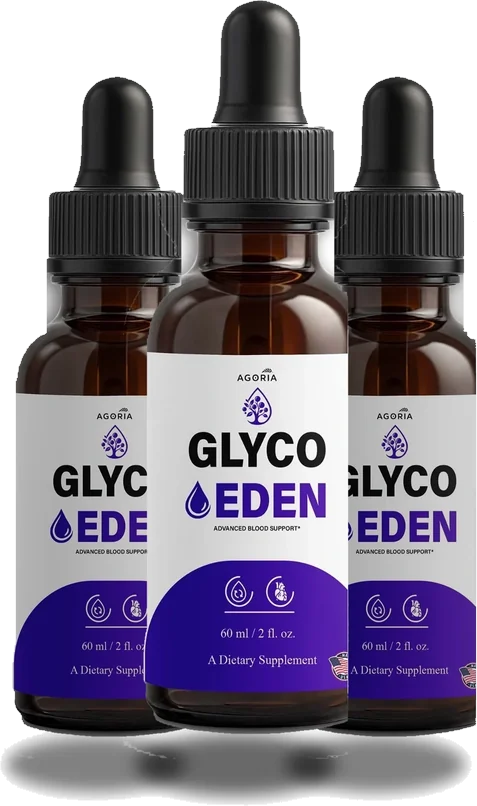
Packs
Three pack sizes. No price, because none was supplied to us — and a guessed price you are then charged something else for is worse than none.
Smallest pack
60 mL total · 30 servings
30 days at two droppers a day
Middle pack
180 mL total · 90 servings
90 days at two droppers a day
Most ordered, per the seller
360 mL total · 180 servings
180 days at two droppers a day
No pack price was supplied to us, so every price on this site reads “shown at checkout”. The figure you will actually be charged is printed on the marketplace listing, and that is the only place it appears. We would rather say that than estimate a number.
The honest section
| Pack | Bottles | Total volume | Servings | Days at 2 droppers | Days at 1 dropper | Cost a day |
|---|---|---|---|---|---|---|
| Single bottle | 1 | 60 ml | 30 | 30 | about 60 | at checkout |
| Three-bottle pack | 3 | 180 ml | 90 | 90 | about 180 | at checkout |
| Six-bottle pack | 6 | 360 ml | 180 | 180 | about 360 | at checkout |
The single bottle. At the top of the label’s range it is one month, which is long enough to know whether a twice-measured daily routine survives contact with your actual life, and short enough that you are not sitting on five unopened bottles inside a refund window whose length nobody has published.
There is a second reason here that does not apply to most products in this category. NCCIH says ashwagandha may be safe when taken in the short term (up to 3 months). The six-bottle pack is six months of product at the label’s own top dose. That is not a reason to avoid it, but it is a reason to have a clinician in the conversation before you buy half a year of it in one click.
Notice what is missing from that table. One column depends on a price no page publishes before checkout, and two more depend on a dosing decision the label leaves to you. Those are three ordinary lines, and none of them is settled.
Safety
| If this applies… | Because of… | What to do |
|---|---|---|
| Any medicine for diabetes | Berberine, and bitter melon | Ask a clinician before your first dose, not after. NCCIH says to talk with your health care provider before taking a supplement if you have diabetes, and never to take one instead of your diabetes medicine. |
| Cyclosporine, or any transplant medicine | Berberine | NCCIH gives cyclosporine as its worked example of a medicine berberine has been shown to interact with. Raise it specifically. |
| Pregnancy or breastfeeding | Berberine, and ashwagandha | NCCIH states that people who are pregnant or breastfeeding should not use berberine and that it should not be given to infants, and that ashwagandha should be avoided during pregnancy. The bottle’s own caution names pregnant and nursing mothers too. |
| Surgery booked in the next fortnight | Ashwagandha | NCCIH lists people about to undergo surgery among those at risk. Tell the surgical team what you are taking. |
| A thyroid or autoimmune condition | Ashwagandha | NCCIH lists individuals with autoimmune or thyroid disorders, and people with hormone-sensitive prostate cancer, among those at risk. |
| Anything that must reach a steady blood level | Black pepper extract | It is in the formula as an absorption aid. Anything that changes how much of one substance reaches the blood can do the same for a medicine you already take. Mention it to a pharmacist. |
| Any known medical condition at all | The formula as a whole | The bottle’s own instruction: individuals with a known medical condition should consult a physician before using this or any dietary supplement. |
NCCIH’s guidance comes in two halves and both matter. Talk with your health care provider before taking a dietary supplement. And: do not take a dietary supplement instead of your diabetes medicine. The same page notes that a few supplements, berberine among them, might help improve blood sugar control, while the evidence remains insufficient for definitive conclusions. Those two statements are not in tension; they are the whole picture.
Ashwagandha. NCCIH says it may be safe when taken in the short term, up to three months, and that although it is rare there have been a number of cases that link liver injury to ashwagandha supplements. Stop and call a clinician if you notice yellowing skin or eyes, dark urine, or unusual tiredness with no explanation.
Reported side effects for the ingredients here are ordinary and mostly digestive: NCCIH lists abdominal pain, constipation, diarrhoea, nausea and vomiting as the most common adverse effects of berberine, and drowsiness, stomach upset, diarrhoea and vomiting for ashwagandha.
No side effects are published for this product itself. Anything you notice is worth reporting to the order desk on +1 (302) 200-3480 and to your own clinician. Read the full safety page →
Expectations
Days 1-7
Before anything else, decide which instruction you are following and write it down. The bottle says one or two droppers; the seller’s panel says two drops. Take the bottle’s, and pick one end of its range rather than drifting between them.
Nothing is published about what week one does.
Weeks 2-4
Four weeks is about the shortest honest window for a daily botanical. At two droppers a day that is most of a bottle, which makes it a natural checkpoint: you will be deciding whether to reorder anyway.
No trial of this formula exists to compare against.
Weeks 4-8
The seller’s own listing says most buyers waited four to eight weeks. Take that as a description of expectation, not of effect, and note that a refund window of unknown length is running somewhere inside it.
The window runs from purchase, not from your first dose.
After 8 weeks
If nothing has changed after two months, that is an answer. NCCIH also notes ashwagandha may be safe when taken in the short term, up to three months, which is a reason to have a clinician in the conversation by this point rather than simply reordering.
Do not take a supplement instead of medicine a clinician has prescribed.
No timeline is published for GlycoEden as a policy, no trial of it exists, and this site publishes no buyer testimony to draw a curve from. So instead of a graph, this is a plan: settle the dose question in week one, four weeks to a first fair look, eight weeks to a decision, and a refund window of unknown length running somewhere inside all of it.
At two droppers a day one bottle is exactly thirty days, which makes the reorder decision and the first fair look land on the same date. Use that. Write down on day one which end of the label’s range you chose and the one thing you would want to be different at four weeks. Memory is generous to things we paid for, and a sentence you wrote before you started is the only honest comparison available. The week-by-week page →
Straight answer
No. GlycoEden is a real product with a real seller, a real phone number and a published returns address in New York. Goglycoeden is the USA Authorized GlycoEden Retailer, and yes, it is for sale here — every buy button on this site goes to one order page.
The question is asked constantly in this category, and it has earned the asking. The FDA keeps a standing page on illegally sold diabetes treatments precisely because products sold near this space have claimed things they are not allowed to claim.
So rather than tell you we are different, here are four things you can check in under five minutes, on this site or on any other:
We would rather you buy nothing than buy from a page that fails those four checks, including this one.
Buying
Through the order page on this site. Goglycoeden is the USA Authorized GlycoEden Retailer, which means we hold stock and sell it in the United States. Orders ship from inside the US and a tracking number arrives in the order email.
We cannot tell you what is in a bottle bought somewhere else — not because we doubt every reseller, but because a lot number is only traceable by the company that shipped it, and a refund route only works through the desk that took the order.
The lot and best-before are printed on the base when the bottle carries them; no best-before appears in the artwork we were given, so check the base of yours. The lot we hold is GLY-26/GO-6566 and the certificate reference is GLY-6566-26-GO. Both are reference codes rather than lab results, and the batch page says so in its first paragraph.
Check the safety seal before anything else. The label is explicit: do not use it if the seal is damaged or missing.
Buyers
The seller publishes a score and some counts. We publish those as the seller’s, and we do not publish the eight named buyers at all.
The seller’s figures, not ours
The pack we were given lists eight buyers by first name, age and city. Three of those eight carry the same sentence word for word, three more share a second, and the remaining two share a third. Eight people did not independently write three sentences. That is layout copy with names typed over it, and publishing it as testimony would be inventing customers. So this page carries none of it, and the structured data on this site contains no rating.
How we source a factThe honest section
Six questions the order desk gets, answered as they were asked. We agree with five of them.
Two droppers, because that is what the bottle says and the bottle is the regulated document. The seller’s panel is wrong by a wide margin, and it is the first thing we would ask them to correct.
Four extracts in unknown proportions, one of which is there to help the others absorb. The panel lists them in descending order by weight, so berberine is the largest share and black pepper the smallest, and that is the whole of what the word proprietary leaves you.
Because US rules allow it. A manufacturer may declare a blend total instead of each ingredient, provided the ingredients are listed in descending order by weight. It is legal, it is common, and here it sits oddly next to a panel that went to the trouble of printing extract ratios.
Because none was supplied to us. Estimating one and having you charged something else at checkout would be worse than saying so.
We do not know, and that is not a satisfying answer. The pack says only “as printed on the marketplace listing”. Read it there, screenshot it, and keep the order email.
No. NCCIH’s guidance could not be plainer: do not take a dietary supplement instead of your diabetes medicine. Nothing on this label claims to treat anything, and a supplement that did would be breaking the law.
Refunds
There is a money-back seal on the packaging, and the supplied pack says the guarantee is “as printed on the marketplace listing”. The supplied pack says the guarantee is “as printed on the marketplace listing” and gives no number of days. The seller’s own review summary mentions a 60-day window, but no policy text states it, so we do not print it as fact. Read the window on the listing before you pay, and screenshot it with the date showing.
The website desk at [email protected] cannot see orders and cannot process a refund. Use the phone line.
Refunds are credited 3 to 5 business days after the order desk approves them, then 5 to 10 days for the card to post it.
Return postage is the buyer’s, and the window runs from purchase rather than from your first dose. Both are normal for this category, and both are worth knowing before you buy six bottles.
This is the one thing we would most want fixed about this product’s paperwork after the dose contradiction, so it is worth repeating. Nothing supplied to us states how long the window is. Read it on the listing at the moment you pay, screenshot it with the date visible, and keep it with the order email.
The honest section
Eight marks out of ten, averaged. 4.6 is a middling score, and a page that gave this label an eight would not be worth reading.
| What we scored | Mark | Why |
|---|---|---|
| Label transparency | 7/10 | A real Supplement Facts panel with a declared 200 mg blend, a named species for two of the four ingredients, a plant part for one, and printed extract ratios for three. That last one is rare enough to be worth saying twice. It still stops at the word “proprietary”. |
| Dosing clarity | 3/10 | The bottle gives a range rather than a dose, and the seller’s own panel contradicts it in a different unit. “2 Drops Daily” against “1 or 2 droppers full daily” is the widest gap we have seen on a label this otherwise careful. |
| Strength for the category | 4/10 | 200 mg split four ways, one of which is an absorption aid. That is a larger blend total than most droppers in this category print, and it is still a small number once three ingredients share it. |
| Price clarity | 2/10 | No pack price was supplied to us at all. Every figure on this site reads “at checkout”, which is the weakest position a buyer can shop from. |
| Money-back window | 4/10 | A money-back seal is printed on the packaging, but no supplied document states how long the window is. “As printed on the marketplace listing” is a pointer, not a policy. |
| Support and contact | 9/10 | A US phone line, a website email with published hours, a named office and a separate returns address. Most supplements in this category publish far less. |
| Published evidence for this formula | 2/10 | No trial of this blend has been published. Every reference on this site is about a single ingredient, and the federal page covering the category says research on these herbal supplements has not proven them effective. |
| Safety disclosure on the label | 6/10 | The caution panel names pregnancy, nursing, under-18s and known medical conditions, which is more than most. It does not mention the liver-injury reports for ashwagandha, or that berberine should not be used in pregnancy at all rather than discussed with a physician. |
E-E-A-T
Goglycoeden publishes this website. We are the USA Authorized GlycoEden Retailer, we hold stock, and we earn money when an order is placed through this site. That belongs near the top rather than in small type at the bottom, because everything else here should be read with it in mind.
Pages are written and reviewed by the GlycoEden Editorial Desk, which is a team rather than a person. No individual doctor or reviewer is named on this site. That is deliberate: naming a clinician we could not verify would be worse than naming none, and we apply the same standard to the words “Natural & Safe” on this packaging, which we take apart on the testing and quality page.
The eight named buyers. The review block supplied to us lists eight people by first name, age and city. Three carry the same sentence word for word, three more share a second, and the last two share a third. That is layout copy with names typed over it. The seller’s own score and counts appear on our reviews page, labelled as the seller’s; the names do not appear at all, and there is no rating in this site’s structured data.
A price. None was supplied. We could have written a plausible one and let checkout correct it. Every price on this site says “at checkout” instead.
A number of guarantee days. The pack points at the listing and gives no length. We could have written “60 days”, because that figure appears in passing inside the same review block we rejected. We did not, for the same reason.
A tidied-up dose. The easiest thing to do with a product whose listing panel contradicts its own bottle is to quote whichever one reads better. We print both, say which wins, and repeat it wherever a reader might arrive without having seen it.
Sources
Every source above is a government or national-body page, opened and read on September 22, 2026. None of them studied GlycoEden. We cite organisation pages rather than individual trials so you can check each one in a single click, and we do not print study identifiers we have not opened. Where a page is quoted on this site, it is quoted rather than paraphrased.
Questions
GlycoEden is a dietary supplement sold as liquid drops in a 2 fl oz amber glass dropper bottle. The front label reads “AGORIA / GLYCO EDEN / ADVANCED BLOOD SUPPORT* / 60 ml / 2 fl. oz. / A Dietary Supplement”. The Supplement Facts panel declares a 200 mg proprietary blend of four extracts.
Two droppers, if you are taking the top of the label’s range. The seller’s how-to-use panel says “2 Drops Daily” and the bottle says “1 or 2 droppers full daily”. Those are different units: a dropper full is roughly a millilitre, and the panel’s own serving line puts two droppers at about 2 mL. Follow the bottle, which is the regulated document, not the marketing image.
Four extracts, in the order the panel prints them: Berberine HCL (Berberis aristata) Extract 30:1 (root) 5%, Bitter Melon 10:1 Extract, Ashwagandha Extract 10:1 (Withania somnifera), and Black Pepper Extract. The blend total is 200 mg per serving.
Not published. “Proprietary Blend” means the manufacturer declares one total instead of four amounts. US rules allow it, provided the ingredients are listed in descending order by weight - which tells you berberine is the largest share and black pepper the smallest, and nothing more.
It is an extract ratio. A 30:1 extract means thirty parts of raw root were reduced to one part of extract. The “5%” that follows is a standardisation figure. Printing either is unusual on a label in this category, and printing both is rarer still.
For most healthy adults the named ingredients are common in supplements. Three things deserve care: berberine, which NCCIH says should not be used in pregnancy or breastfeeding and may interact with medicines; ashwagandha, which has rare liver-injury reports and a list of groups who should avoid it; and the fact that two of the four ingredients sit in the blood-sugar conversation, which matters if you take medicine for diabetes.
Ask your clinician first, before you buy rather than after. NCCIH’s guidance is explicit on both halves: talk with your health care provider before taking a dietary supplement if you have diabetes, and do not take a dietary supplement instead of your diabetes medicine.
No pack price was supplied to us. Every price on this site reads “shown at checkout”, and the marketplace listing is where the figure you will actually be charged appears.
The packaging carries a money-back seal, and the supplied pack says the guarantee is “as printed on the marketplace listing”. No length was given to us, so we do not print one. Read the window on the listing before you pay and screenshot it with the date showing.
Because three of the eight named buyers in the material supplied to us say the same sentence word for word, three more share a second, and the last two share a third. The seller’s own published figures are on our reviews page, labelled as the seller’s, and nothing is presented as testimony.
53 questions are answered on the full FAQ page, in six groups.
Liquid drops, 60 ml / 2 fl. oz., 30 servings at the panel’s two-dropper serving, and a 200 mg proprietary blend of four extracts. Prices and the money-back window are printed on the listing, and the order desk is on +1 (302) 200-3480. Read the dose section first — the bottle says droppers, not drops, and that is the one thing worth being sure about before you pay.
Price and money-back window on the listing · ships from inside the US · order desk +1 (302) 200-3480