GlycoEden blog
Drops Versus Dropperfuls
Two words that look interchangeable, are not, and sit on opposite sides of the same product’s own paperwork.
Start here
A drop is not a unit
Ask someone to take two drops of something and they will do it without hesitating, because a drop sounds like a measurement. It is not one. It is whatever falls off the end of the thing you are holding.
The volume of a single drop is set by three things, none of them printed on any bottle. The liquid. Surface tension and viscosity decide how large a bead can hang before its own weight pulls it off, and a glycerin-based liquid behaves differently from a thin tincture. The pipette. A wide bore releases a larger drop than a narrow one, and dropper tips are not made to a common size. The hand. Held vertically a pipette gives its smallest, most regular drop; tilted, it gives a larger and less predictable one.
So a drop is a real physical event and a poor instruction. Two people following “two drops” from two different liquids are not taking the same amount, and neither of them can say what amount they took.
The other word
A dropper full is roughly a millilitre
A dropper full is a different kind of word. It still is not an SI unit, but it points at hardware rather than at an event, and the hardware is far more consistent.
The glass pipette in a supplement dropper cap is a manufactured part with a fixed length and bore. Squeeze the bulb and release it and the pipette fills to near the same line every time, because the bulb displaces about the same volume of air every time. On most supplement bottles that line lands at or near one millilitre, which is why so many liquid panels declare a serving of 1 mL or 2 mL and then describe it in droppers.
The caveat
Near a millilitre is not exactly one, and a dropper full is roughly a millilitre on this kind of bottle because that is how these bottles are built, not because anybody legislated it. The way to confirm it on a particular bottle is arithmetic on the panel, and that is the next section.
The practical difference is the point. A dropper full is roughly a millilitre; a drop is a small fraction of one. They are not two sizes of the same instruction. They are more than an order of magnitude apart.
Three checks
How to tell which one a label means
Three checks, in order, and they take under a minute on any liquid supplement.
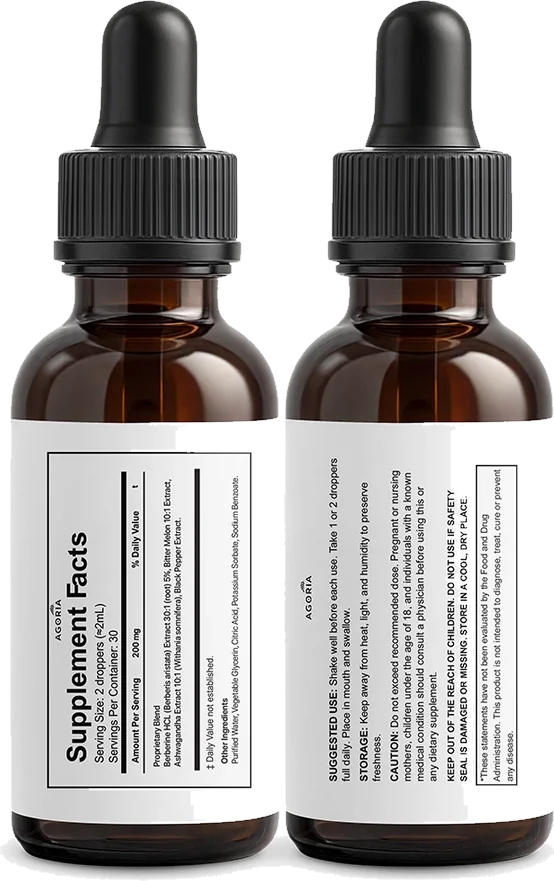
One. Find a serving size in millilitres. A Supplement Facts panel almost always prints one, because a liquid serving has to be declared in a measurable unit. That figure is the anchor.
Two. Divide it. If the panel says the serving is two droppers and about 2 mL, it has told you a dropper is about 1 mL without ever saying so. If servings times serving size comes back to the bottle volume, the arithmetic closes and you can trust the unit. If nothing divides cleanly, the label has not settled its own units and you should not settle them for it.
Three. Check whether the marketing uses the same word as the panel. Listing images and product pages are written by a different hand from the one that produced the regulated artwork, and they are where the word changes. If an image says drops and the bottle says droppers, that is a contradiction rather than a style choice.
A hierarchy
How labels express a liquid dose, best to worst
| What the label does | What you learn from it | How common |
|---|---|---|
| A volume, with the hardware named — “1 mL (one dropper full)” | Everything. The unit is measurable and the hardware is calibrated against it on the same line | The minority |
| A volume on the panel, hardware in the directions — a serving declared in mL, a dose written in droppers | Enough. One division reconciles the two, and GlycoEden is here | Common, and usually fine |
| Hardware only, with a serving you can divide — droppers everywhere, but a mL figure somewhere on the panel | The volume, if you do the arithmetic yourself | Common on tinctures |
| Drops, with a volume to reconcile them against | Little. Drop size is set by the liquid, the bore and your hand | Frequent in marketing copy |
| Drops, with no volume anywhere | The manufacturer’s intent, and nothing else | Very common, and the row to walk away from |
The step between the fourth row and the third is the one that matters. Once a millilitre figure exists anywhere on the artwork, a reader can reconstruct the dose. Without one, nobody can — not the buyer, not the seller, and not the person who wrote the instruction.
Applied to this label
A worked example: two drops against two droppers
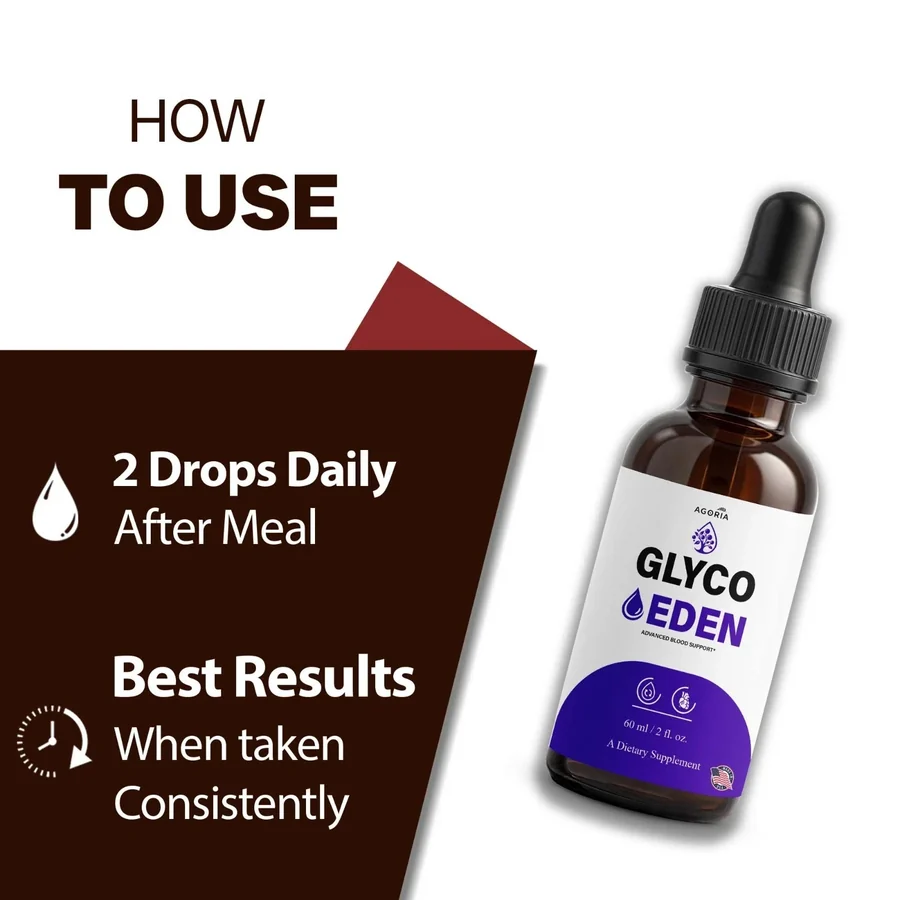
The seller’s how-to-use panel says “2 Drops Daily”. The bottle says “Take 1 or 2 droppers full daily”. Those are not the same instruction and they are not the same unit. A dropper full is roughly a millilitre; the panel itself declares a serving of two droppers at about 2 mL, which puts one dropper at about 1 mL. A drop is a fraction of that. Two drops is not a smaller version of two droppers, it is a different order of magnitude.
Run the three checks on it. The panel prints a serving size of 2 droppers (≈2mL) and 30 servings in a 60 ml / 2 fl. oz. bottle. Two millilitres times thirty is sixty, which is the bottle. The arithmetic closes, so a dropper full here really is about one millilitre.
Then the third check fails. The seller’s how-to-use image says drops; the bottle says droppers full. Two drops is not a cautious version of two droppers, and on this bottle it would leave the declared thirty servings nowhere to go: at two drops a day a 60 mL bottle would last years rather than a month.
Which one to follow
Follow the bottle, not the panel. Where a label and a marketing image disagree, the label is the regulated document and the image is not. The Supplement Facts panel and the directions panel are the documents a manufacturer is accountable for. A listing image is marketing, it can be edited by somebody who never saw the artwork, and it carries none of that weight. Follow the bottle.
The range
The second problem: one dropper or two
Settling the unit does not finish the job here, because the bottle’s own instruction is a range rather than a figure. It reads “take 1 or 2 droppers full daily”, and the two ends are not close together.
What the range does to strength
The panel declares one serving as two droppers and attaches a 200 mg proprietary blend to it. Take two droppers and you are taking the serving that figure describes. Take one and you are taking half of it, and the only amount printed anywhere on the artwork no longer applies to what is in your mouth. The label lets you pick without telling you it has handed you the choice.
What it does to how long a bottle lasts
At two droppers a day the bottle is thirty servings and thirty days. At one it is sixty days. Whatever a pack costs at checkout, the cost per day at the bottom of the range is half the cost per day at the top, so any comparison you run against another product depends on which end you picked.
What to do about it
Pick one end before the first dose and stay there. Drifting between one and two droppers makes the thirty servings on the panel useless as a planning figure. If you want the dose the printed 200 mg describes, that is two droppers.
Caveats
Two things this will not tell you
It will not tell you how much of anything you are taking
Settling millilitres settles volume, not content. On this bottle the 200 mg is a blend total shared by four extracts with no figure printed against any of them, so knowing you took 2 mL tells you the weight of the blend and nothing about its parts.
It will not tell you whether the dose is a sensible one
No Daily Value is established for any of this, and the panel says so in its own footnote. There is no reference figure to hold a serving against, so a reconciled unit tells you what you took and leaves open whether it was worth taking. If you take prescribed medicine or have a diagnosed condition, that is a question for the person treating you.
Summary
The one-minute method
Four steps, about a minute, and it works on any dropper bottle in any category. One. Find the serving size in millilitres on the Supplement Facts panel. Two. Divide it by whatever hardware word sits beside it, and check that servings times serving size comes back to the bottle volume. Three. Read the directions and the marketing images side by side and notice whether they use the same word. Four. Where they differ, follow the label and treat the image as the error, because that is the way round the documents rank.
If step one finds nothing, you are finished in ten seconds instead of sixty, and the answer is that the product has not told you what a dose is.
References
Sources for this GlycoEden post
- NIH Office of Dietary Supplements. Dietary Supplements: What You Need to Know. ods.od.nih.gov. Accessed September 22, 2026.
- U.S. Food and Drug Administration. Information for Consumers on Using Dietary Supplements. www.fda.gov. Accessed September 22, 2026.
- National Center for Complementary and Integrative Health. Using Dietary Supplements Wisely. www.nccih.nih.gov. Accessed September 22, 2026.
Order GlycoEden from the official page
Liquid drops, 60 ml / 2 fl. oz., 30 servings at the panel’s two-dropper serving. Prices and the money-back window are printed on the listing, and the order desk handles anything after you pay. Before you pay, know that no per-ingredient amount is printed anywhere.
Price and money-back window on the listing · ships from inside the US