Official product information
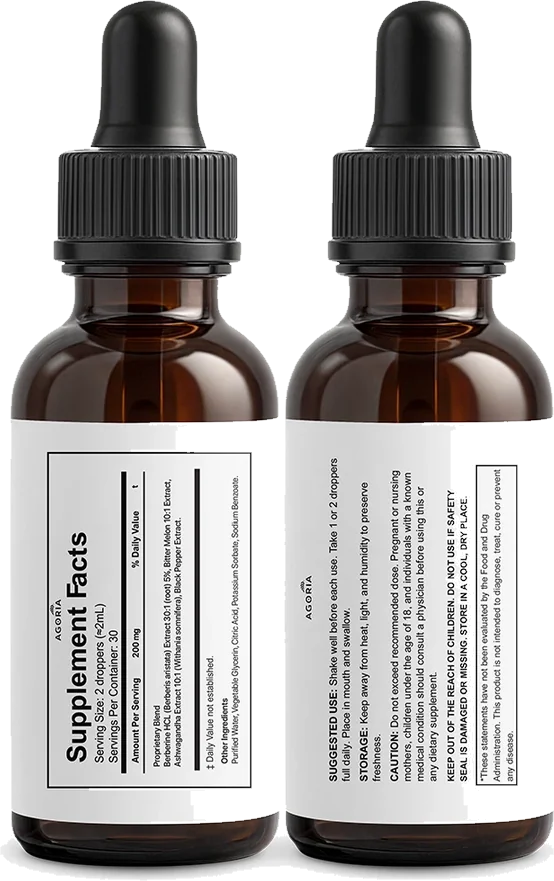
GlycoEden Supplement Facts: The Whole Panel, Transcribed
Every line on the back and side of the GlycoEden bottle, transcribed word for word, with the arithmetic checked and the omissions listed.
Written and reviewed by the GlycoEden Editorial Desk · Last updated September 22, 2026
Quick answer
The GlycoEden Supplement Facts panel declares a serving size of 2 droppers (about 2mL), 30 servings per container and a 200 mg figure printed on the Amount Per Serving header row, describing a Proprietary Blend of four extracts. The footnote reads “Daily Value not established”. Other ingredients are purified water, vegetable glycerin, citric acid, potassium sorbate and sodium benzoate. The directions read “1 or 2 droppers full daily”, which makes the bottle a 30-day or a 60-day supply depending on which end of that range you take.
The label
The GlycoEden Supplement Facts panel, transcribed
Three serving lines, four extracts, a footnote and five other ingredients. That is the whole panel.
Serving lines, word for word
- Serving Size: 2 droppers (about 2mL)
- Servings Per Container: 30
- Amount Per Serving · 200 mg · % Daily Value ‡
Proprietary Blend, containing
- Berberine HCL (Berberis aristata) Extract 30:1 (root) 5%
- Bitter Melon 10:1 Extract
- Ashwagandha Extract 10:1 (Withania somnifera)
- Black Pepper Extract
Footnote and other ingredients
‡ Daily Value not established. That footnote is not a warning. It means no US reference intake exists for these botanicals, so the panel has no percentage it could honestly print — and no official yardstick exists to measure 200 mg against.
Other Ingredients: Purified Water, Vegetable Glycerin, Citric Acid, Potassium Sorbate, Sodium Benzoate.
A checkable detail
Where the 200 mg is actually printed
One oddity in the typesetting
The 200 mg is printed on the Amount Per Serving header row rather than against the Proprietary Blend line beneath it. It plainly describes the blend, because there is nothing else on the panel for it to describe. It is simply set one row higher than a reader expects.
We raise it for two practical reasons rather than to score a point.
The first is that people photograph panels and squint at them later. A figure sitting on a header row reads, at a glance, like a column heading rather than a value, and a buyer scanning the blend line can come away believing no amount was printed at all. It was. It is one line up.
The second is that it is worth checking on the bottle you actually receive. Panels get re-typeset between print runs. If yours puts the figure against the Proprietary Blend line, nothing is wrong — the artwork has moved on. If it puts a different number anywhere, that is worth a call to the order desk on +1 (302) 200-3480 before you take anything.
What the placement does not change is the meaning. 200 mg is the total for four extracts together in a two-dropper serving, and no part of the panel divides it. What that leaves you with →
Checking the numbers
Does the panel add up? The 60 mL arithmetic
Six lines of arithmetic, and one of them turns a 30-day bottle into a 60-day one.
| What the label prints | The figure | What it works out to |
|---|---|---|
| Bottle volume, front | 60 ml / 2 fl. oz. | 60 millilitres of liquid. |
| Serving size, panel | 2 droppers, about 2 mL | One dropper is therefore about 1 mL. |
| Servings per container, panel | 30 | 60 divided by 2 is 30. The panel agrees with the bottle. |
| Suggested use, directions panel | 1 or 2 droppers full daily | A range rather than a dose: 1 mL or 2 mL a day. |
| At the top of the range | 2 droppers daily | One full serving, 200 mg, and a 30-day bottle. |
| At the bottom of the range | 1 dropper daily | Half a serving, half the blend, and a bottle lasting about 60 days. |
So the arithmetic is sound, and it is the directions that introduce the uncertainty. A bottle is a 30-day supply or a 60-day supply depending on which end of the label’s own range you take, and the 200 mg describes the top end only. At one dropper a day, the number printed on the panel is not the number in your mouth.
That moves more than the strength. It moves the cost per day, and it moves how many months a multi-bottle pack really is. Neither is written down anywhere, because the label leaves the decision to you and the seller’s materials do not resolve it. How we would settle it →
Suggested use
The directions panel, word for word
The third panel carries the directions, the storage line and the caution. Here is the first of them, word for word.
“SUGGESTED USE: Shake well before each use. Take 1 or 2 droppers full daily. Place in mouth and swallow.”
Three instructions in one line: shake, take one or two droppers full daily, swallow. No time of day is specified anywhere on the bottle, and no relationship to food is specified either.
And the line the seller’s panel contradicts
The seller’s how-to-use panel says “2 Drops Daily”. The bottle says “Take 1 or 2 droppers full daily”. Those are not the same instruction and they are not the same unit. A dropper full is roughly a millilitre; the panel itself declares a serving of two droppers at about 2 mL, which puts one dropper at about 1 mL. A drop is a fraction of that. Two drops is not a smaller version of two droppers, it is a different order of magnitude.
Follow the bottle, not the panel. Where a label and a marketing image disagree, the label is the regulated document and the image is not. The Supplement Facts panel and the directions panel are printed on the regulated label of the bottle in your hand. A square image on a listing page is marketing, and on this product it is the marketing that is wrong. This page transcribes the label, so the label is what it prints. The full dosing page →
The small print
Storage, caution and the three warnings
Storage
“STORAGE: Keep away from heat, light, and humidity to preserve freshness.”
Three enemies named. The amber glass handles the light and does nothing about the other two, which is why the bottle also says to store it in a cool, dry place. A kitchen cupboard clears all three; a bathroom shelf fails two.
The three block-capital warnings
- KEEP OUT OF THE REACH OF CHILDREN.
- DO NOT USE IF SAFETY SEAL IS DAMAGED OR MISSING.
- STORE IN A COOL, DRY PLACE.
The middle one is not boilerplate. A safety seal is the only evidence you get that nobody opened the bottle between the filling line and your hand.
Caution
“CAUTION: Do not exceed recommended dose. Pregnant or nursing mothers, children under the age of 18, and individuals with a known medical condition should consult a physician before using this or any dietary supplement.”
Four groups named: everyone, on not exceeding the dose; pregnant or nursing mothers; children under 18; and anyone with a known medical condition. That is a fuller caution than much of this category prints, and it is worth saying so.
It is not the whole list the federal summaries would produce. NCCIH states that people who are pregnant or breastfeeding should not use berberine, which is firmer than consulting a physician about it. NCCIH also lists people about to have surgery, people with autoimmune or thyroid disorders and people with hormone-sensitive prostate cancer among those at risk from ashwagandha, and none of those appears on the bottle — nor do the rare cases NCCIH reports linking liver injury to ashwagandha supplements. Our safety page carries all of it →
The gaps
What is not printed on this label
Everything a reader might reasonably look for on this panel and not find.
Not on the front, the back or the side. No “manufactured for” line, no “distributed by” line, no city. The brand mark Agoria above the wordmark is the whole of the corporate identification on this bottle, and that absence is the most unusual thing about the artwork.
None appears in the images supplied to us. Where a bottle carries one it is normally stamped on the base, so check the base of yours.
The 200 mg is the blend total. Four extracts share it and the panel does not divide it.
For any of the four. Standard for the category, and still part of what an extract ratio means.
No “contains” or “free from” line. The other-ingredients list is short enough to read in full, which is the next best thing.
Lot GLY-26/GO-6566 and certificate reference GLY-6566-26-GO are codes. No document was supplied with either, so there is nothing to open and nothing to read.
Six absences, not equally serious. The missing split costs a reader most. The missing address would catch a regulator’s eye first. The missing certificate is the one most easily mistaken for its opposite, because a lot code printed beside the word certificate looks like evidence and is not. What those two codes are →
Questions
GlycoEden FAQ: supplement facts questions
What is GlycoEden?
GlycoEden is a dietary supplement sold as liquid drops in a 2 fl oz amber glass dropper bottle. The front label reads “AGORIA / GLYCO EDEN / ADVANCED BLOOD SUPPORT* / 60 ml / 2 fl. oz. / A Dietary Supplement”. The Supplement Facts panel declares a 200 mg proprietary blend of four extracts.
Who makes GlycoEden?
The brand mark printed above the wordmark on the label is Agoria. No manufacturer address, distributor line or factory is named anywhere in the material supplied to us, which is unusual - most labels carry at least a “distributed by” line.
Is there a best-before date on the bottle?
None appears in the artwork supplied to us. The pack says the lot and best-before are printed on the base when the bottle carries them, so check the base of the bottle you receive.
What does “Daily Value not established” mean?
It means no US reference intake exists for these botanicals, so the panel cannot print a percentage. It is a normal and honest line on a herbal label, not a warning - but it does mean there is no official yardstick to measure 200 mg against.
Does it need refrigerating?
No. The label says to keep it away from heat, light and humidity, and to store it in a cool, dry place. Amber glass is used because it blocks light, so a cupboard beats a windowsill.
Is it FDA approved?
No dietary supplement is. The FDA is not authorised to approve supplements for safety and effectiveness before they are sold. A seal reading “FDA-registered facility” describes a factory’s registration, not this product.
References
Sources for this page
- NIH Office of Dietary Supplements. Dietary Supplements: What You Need to Know. ods.od.nih.gov. Accessed September 22, 2026.
- U.S. Food and Drug Administration. Information for Consumers on Using Dietary Supplements. www.fda.gov. Accessed September 22, 2026.
- National Center for Complementary and Integrative Health. Using Dietary Supplements Wisely. www.nccih.nih.gov. Accessed September 22, 2026.
- NIH Office of Dietary Supplements. Botanical Dietary Supplements: Background Information. ods.od.nih.gov. Accessed September 22, 2026.
Next
Keep reading
The four extracts in full
What the printed ratios mean, and the column that reads not published.
Read it →Droppers, not drops
The contradiction between the bottle and the seller’s panel, settled.
Read it →The lot and certificate codes
What a reference code is, and why it is not a laboratory report.
Read it →Order GlycoEden from the official page
One bottle is 60 ml / 2 fl. oz. and 30 servings at the panel’s two-dropper serving. Prices and the money-back window are printed on the listing rather than here. Order desk +1 (302) 200-3480.
Price and money-back window on the listing · ships from inside the US · order desk +1 (302) 200-3480